By TAKO Digital Marketing · Category: Performance Marketing · www.takodigitalmarketing.com

Not sure where your ad budget is leaking? Let us take a look.
Most Malaysian B2B ad accounts lose money in the same few places: tracking that counts the wrong events, landing pages that confuse mobile visitors, audiences that are too wide, and sales results that never reach the ad platform. You don’t need to guess which one is costing you.
Impressions do not settle supplier invoices, and clicks do not meet payroll. This guide shows Malaysian B2B brands how performance marketing optimization turns an advertising budget into a system you can measure, test and improve every single week.
Open almost any B2B ad report in Malaysia and the headline figures are the easy ones: how many people saw the ad, how many tapped it, how many followed the page. They are comforting to read. Yet none of them buys raw materials, covers rent or pays a salary. Performance marketing optimization begins with a tougher question: which ad, audience, page and bid brought in actual revenue, and how do we repeat that for less money?
The question matters most to tech startups, manufacturers and growth-stage service firms. Their buyers compare carefully, deals take weeks or months to close, and every ringgit spent on ads is a ringgit not spent on hiring, stock or machinery. When budgets are tight, performance marketing optimization is what separates campaigns that scale from campaigns that quietly burn cash.
Below you will find a plain-language definition, the reasons budgets leak, five pillars that hold an optimization engine up, a weekly routine for bringing your cost per acquisition down, a sensible way to divide money between performance and brand, and straight answers to common questions.
THE SHORT ANSWER
Performance marketing optimization is a loop, not a one-off setup. Track events that signal real intent, find the biggest leak, change one thing, wait for enough data to judge it, then move budget toward whatever wins. Teams that run this loop weekly steadily improve their cost per acquisition, while teams that adjust campaigns on instinct keep guessing. No agency can promise a specific ROAS or CPA, because results depend on your offer, your market and how quickly your sales team follows up.
Three terms appear throughout this guide:
- ROAS (return on ad spend) is revenue divided by ad spend.
- CPA (cost per acquisition) is ad spend divided by the number of conversions.
- CVR (conversion rate) is conversions divided by clicks.
SECTION 01
What Is Performance Marketing Optimization?
Performance marketing means paying for measurable actions, such as a lead, a phone call, a demo request or a sale, instead of paying for exposure. Performance marketing optimization is the continuing effort to make those actions cheaper, more valuable and more frequent by steering budget toward the channels, audiences and creatives that deliver.
The word that matters is “continuing”. A campaign that is switched on and ignored is not optimized, however careful the setup was. Platforms tweak their algorithms, rivals change their offers and buyers change their habits, so performance marketing optimization relies on a feedback loop: measure, learn, adjust and measure again.
Numbers that look good versus numbers that pay
Most dashboards are happy to show the first group below. Budget decisions should come from the second.
- Reporting-friendly numbers: impressions, followers, likes, raw click-through rate, page visits and the total count of enquiries.
- Budget-deciding numbers: cost per qualified lead, conversion rate from click to lead, cost per acquisition, close rate, ROAS and profit per customer.
Clicks and impressions remain handy for diagnosing a problem, but they are never the goal.
Why a loop? Because every ad platform learns from the conversion data you send back. Clean, meaningful data lets the algorithm find more buyers like your best ones. Thin, duplicated or mislabelled data teaches it to chase the wrong behaviour, and you foot the bill. Good performance marketing optimization therefore starts with data quality and ends with decisions, never the other way round.
SECTION 02
Why Malaysian B2B Brands Leak Ad Budget
Wasted spend seldom comes from one dramatic blunder. It seeps out through small, ordinary gaps, like coins escaping a bucket with a few pinholes. The same handful of gaps show up again and again in the accounts we review, and performance marketing optimization exists to close them.
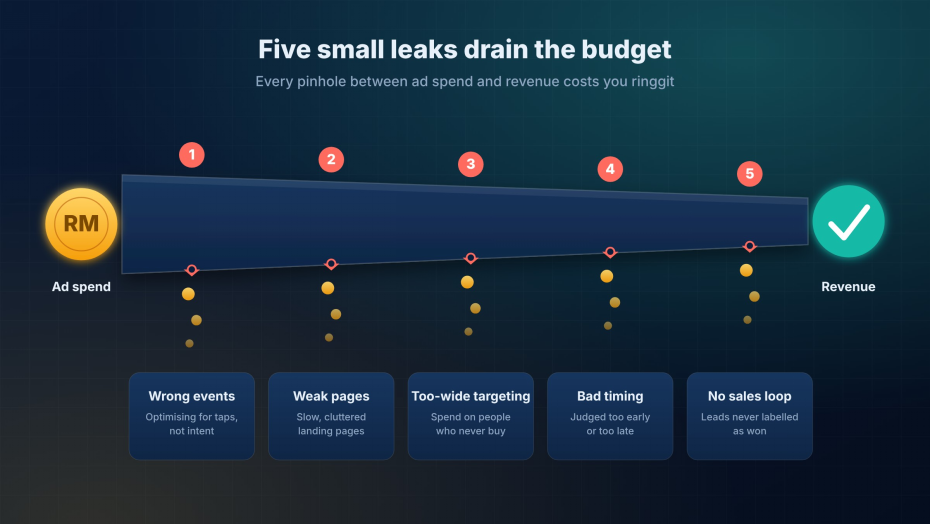
Five small leaks, big losses.
- Counting the wrong events. Many accounts optimise for page views or button taps because they are easy to set up, so the algorithm hunts cheap clicks instead of buyers. Performance marketing optimization needs events that reflect real intent, such as a submitted quotation form, a WhatsApp tap or a booked call.
- Sending good ads to weak pages. A strong ad pointing at a slow, cluttered or confusing page is a leaking bucket. If a mobile visitor cannot tell what you sell and how to ask for a quote within a few seconds, you are paying for traffic that never converts.
- Targeting too wide. Broad audiences can work once the data is clean, but without good signals they spend freely on people who will never buy. B2B brands often need tighter targeting by industry, job role, company size or search intent.
- Judging too early or too late. Pausing an ad after one bad day wastes a test, while letting an obvious loser run for a month wastes budget. Both are lapses in performance marketing optimization discipline.
- Leaving sales out of the loop. If nobody reports which leads became customers, the platform learns from raw form fills. To an algorithm, a student’s enquiry and a procurement manager’s enquiry look identical unless you tell it otherwise.
A quick symptom check
Match what you see in your account with the most likely cause:
- Plenty of clicks but few leads usually points to a weak landing page or the wrong audience. Rewrite the offer, tighten targeting and shorten the form.
- Plenty of leads but few customers suggests low-quality leads or slow follow-up. Add qualifying questions and reply the same day.
- A CPA that climbs month after month often means creative fatigue or new competitors. Refresh creatives and retest audiences.
- Platform numbers that disagree with your sales records hint at broken or duplicate tracking. Audit pixels, tags and CRM links.
- Budget piled into a few campaigns for no clear reason means there is no reallocation rule. Set weekly spend-shift rules.
If two or more of these sound familiar, performance marketing optimization will probably return more than adding budget to the same setup.
SECTION 03
The 5 Pillars of a High-Performing Optimization Engine
A dependable performance marketing optimization engine stands on five pillars. Each one strengthens the next, and results travel back to the start so the whole structure keeps improving.
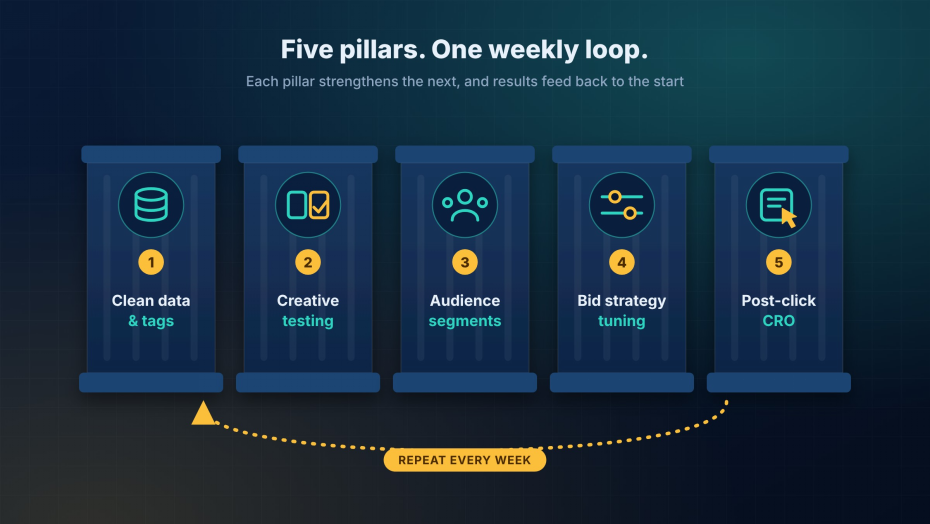
Five pillars, one continuous loop.
Pillar 1: Clean data and tags
Everything else rests on this pillar. Install tags correctly, remove duplicate events, define one conversion that stands for a genuine lead and connect your CRM so closed deals can be reported back. Use Google Analytics and each platform’s conversion tools to confirm the numbers agree before you change a single bid. Performance marketing optimization built on bad data only optimises the wrong thing faster.
Pillar 2: A creative testing habit
Test one variable at a time: headline, offer, image, format or call to action. Keep a simple log of what you tried, why and what happened. Our free ad copy generator can help you draft variations quickly. The purpose of creative testing in performance marketing optimization is learning, not novelty, so every test should answer a question you can act on.
Pillar 3: Audience segmentation
Performance marketing optimization works best when each audience receives its own message. Separate cold audiences, warm audiences such as site visitors, and existing contacts, then measure each on its own. In B2B, segment by industry, role and buying stage. Someone who types a product name plus “supplier” or “quotation” needs a different ad from someone reading a how-to article. Our B2B social media marketing work follows the same principle of matching the message to the buyer.
Pillar 4: Bid strategy tuning
Match the bid strategy to the data you hold. Manual or simple bidding suits new accounts with few conversions, while automated strategies that aim for a target CPA or ROAS need enough conversion history to learn. The Google Ads Help Centre lists the requirements for each campaign type. Good performance marketing optimization changes bid targets gradually and one at a time, so you can see what caused any shift.
Pillar 5: Post-click conversion rate optimization
The click is not the finish line. Improve page speed, headline clarity, trust signals, form length and the WhatsApp or call button. A small lift in conversion rate lowers your CPA across every campaign at once, which makes post-click work some of the highest-return performance marketing optimization you can do.
SECTION 04
A Weekly Routine to Lower Your Cost per Acquisition
Use this routine every week or every second week. Each step hands over to the next, and the result of one round becomes the starting point of the following round.
Step 1: Audit tracking and the funnel
Confirm that every conversion is recorded once, labelled correctly and visible in your reports. Then walk through the funnel as a buyer on a phone and note the point where you would give up. Every round of performance marketing optimization begins here.
Step 2: Diagnose the biggest leak
Work out where the largest drop happens: from impression to click, click to visit, visit to lead, or lead to customer. In performance marketing optimization, fix the biggest drop first, because it moves CPA the most.
Step 3: Test one change at a time
Change a single thing, such as the offer, the audience or the landing page headline, and keep everything else steady. If you change five things at once you will never know which one worked. Clean tests are the backbone of performance marketing optimization.
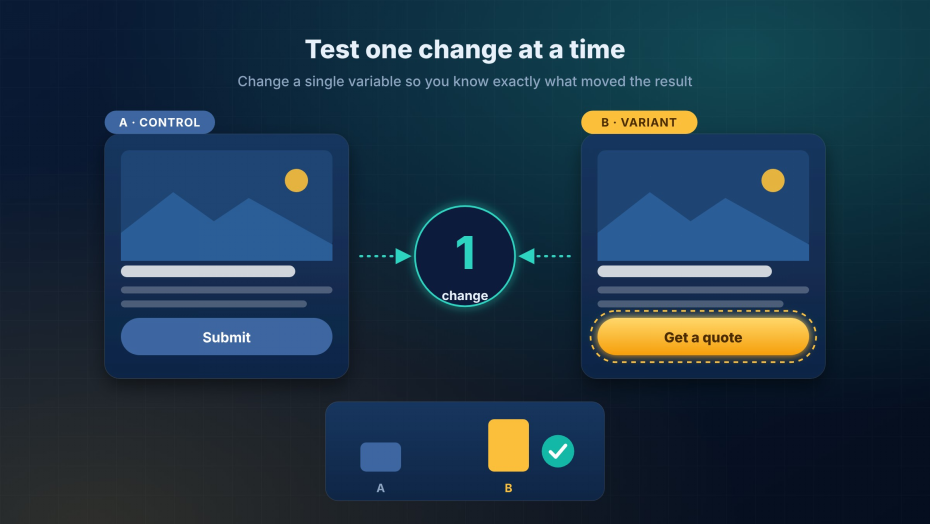
Change one variable, and you know what moved the result.
Step 4: Judge with enough data
Judging results is the hardest part of performance marketing optimization, and it is where many teams slip. The popular “3-day rule” says to evaluate an ad after three days. It is a handy reminder not to react to a single day of noise, but it is not a statistical test. A fixed window ignores volume, so a low-traffic ad may have almost no real data after three days. Statistical significance, by contrast, asks whether the gap between two versions is bigger than chance alone would produce.
In practice, treat the 3-day rule as a floor, not a verdict. Wait until you have enough conversions to compare versions with confidence, cover at least one full week so weekday patterns are included, and run the numbers through a free significance calculator. Platform learning phases add a second reason for patience: Meta has described needing roughly 50 optimization events per ad set per week to leave its learning phase, and Google Ads smart bidding needs a learning period too. Check each platform’s current documentation, because these figures change.
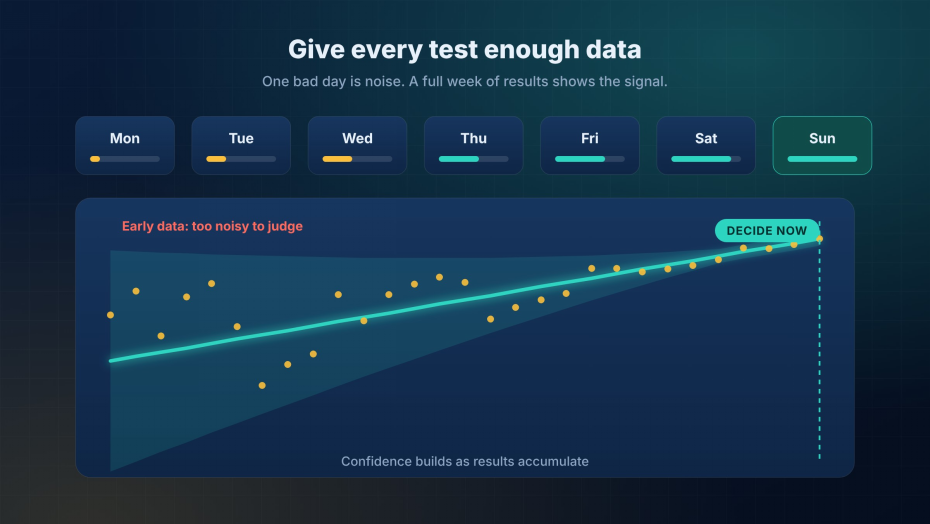
Give every test a full week before you judge it.
Step 5: Reallocate budget
When a result is clear, move budget in steps, for example 10 to 20 percent at a time, from the weakest campaigns toward the strongest. Sudden jumps can reset learning and distort results. Keep a small test budget running so fresh ideas keep arriving. This weekly reallocation is the heart of performance marketing optimization.
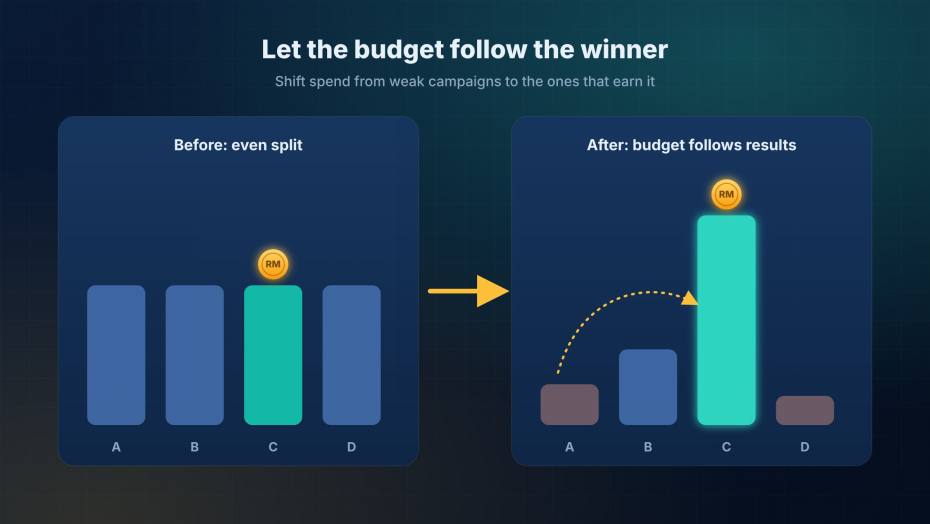
Let the budget follow the winner.
A worked example (illustrative numbers)
The figures in this example are invented to show the maths. Swap in your own.
Imagine a company spending RM6,000 a month and collecting 40 tracked leads from forms and WhatsApp taps. That makes each lead cost RM150. Its sales team judges 10 of those leads to be qualified, and 2 of them become customers. Dividing RM6,000 by 2 gives a cost per acquisition of RM3,000. Whether that is healthy depends entirely on the gross profit each customer brings.
Now suppose performance marketing optimization improves the lead form and a weak campaign is paused, so that 14 leads qualify and 3 become customers on the same RM6,000. The cost per acquisition falls to RM2,000, and not a single extra ringgit was spent. Test your own version with our free ROI calculator for Google Search Ads, which estimates cost per click, conversion rate, ROAS and ROI from your monthly numbers.
SECTION 05
Performance Versus Brand: Dividing the Budget for Malaysian SMEs
Performance marketing optimization does not make brand marketing worthless. B2B buyers research several suppliers, remember the ones they trust and often search for a company by name before enquiring. Brand work makes performance campaigns cheaper over time, while performance data shows which brand messages deserve repeating. Think of the brand as the lighthouse that people steer toward, and performance as the speedboat that gets them to the dock.
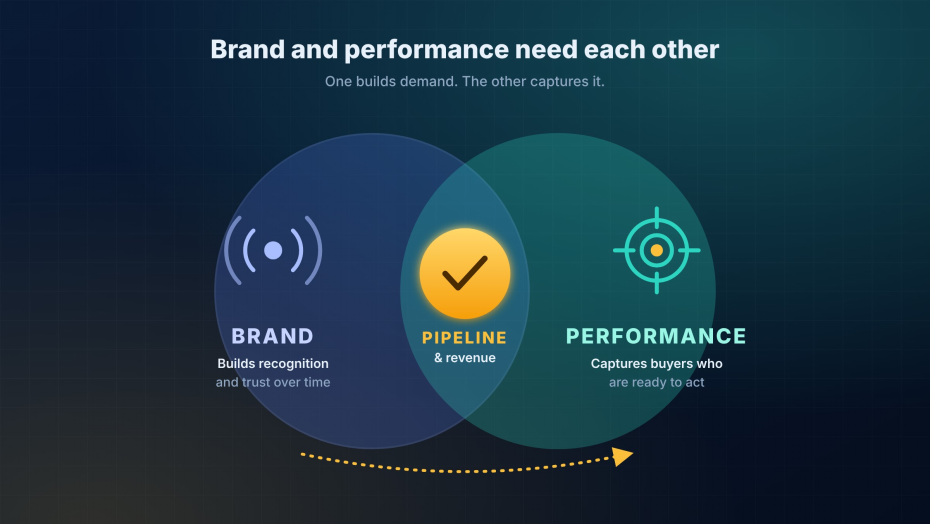
Brand builds demand; performance captures it.
The right split depends on your stage and sales cycle, so treat the ranges below as starting points to test rather than rules:
- New business or small budget: about 80 to 90 percent on performance and 10 to 20 percent on brand and content. Prove that one channel works before widening.
- Growing business with steady leads: about 65 to 80 percent on performance and 20 to 35 percent on brand. Add case studies, SEO and retargeting.
- Established business with long cycles: about 55 to 70 percent on performance and 30 to 45 percent on brand. Invest in authority and repeat buyers.
Review the split every quarter as part of your performance marketing optimization routine. If branded search and direct enquiries rise while paid CPA stays steady, brand work is helping. If CPA climbs and branded demand is flat, move more budget into tested performance channels. For companies that also want steady organic growth, our guide to affordable SEO services shows how search work can lower reliance on paid clicks over time.
SECTION 06
Frequently Asked Questions About Performance Marketing Optimization

Straight answers to the questions B2B teams ask most.
What is the difference between performance marketing and digital marketing?
Digital marketing is the broad term for promoting a business online, including SEO, content, social media, email and ads. Performance marketing is the paid part, measured by specific actions such as leads or sales. Performance marketing optimization is the ongoing work of improving those measured results.
What is the minimum budget needed for performance marketing optimization?
There is no universal minimum, because it depends on your cost per click and conversion rate. Optimization needs enough conversions to learn from, and a very small budget may not produce them, leaving you to guess. Many B2B brands start with a focused budget on one channel and one clear offer, then grow once the data is reliable.
How long does the algorithm learning phase last?
It varies by platform and campaign type. Platforms generally need a minimum amount of conversion data before results settle, and Meta has described roughly 50 optimization events per ad set per week. Avoid big edits during learning in any performance marketing optimization routine, because they can restart it. Check each platform’s current guidance.
How often should I optimize my campaigns?
For performance marketing optimization, review key metrics weekly, make changes in small steps and run larger structural reviews monthly or quarterly. Daily checks are fine for catching errors, but avoid daily reactions to normal fluctuation.
Which metrics matter most in performance marketing optimization?
Cost per qualified lead, cost per acquisition, conversion rate and ROAS tell you whether campaigns make money. Click-through rate and impressions help with diagnosis but should not drive budget decisions on their own.
Can performance marketing optimization guarantee a lower CPA?
No honest provider can guarantee a specific CPA or ROAS. Results depend on your offer, pricing, website, competition and sales follow-up. A good process improves your odds and shows you clearly what is and is not working.
Do B2B companies need a different approach to performance marketing optimization?
Often, yes. B2B sales cycles are longer, buyers involve several people and lead quality matters more than lead volume. That is why connecting ad data to your CRM and judging campaigns on qualified leads and customers is so important.
SECTION 07
Conclusion: Make Performance Marketing Optimization Your Growth System
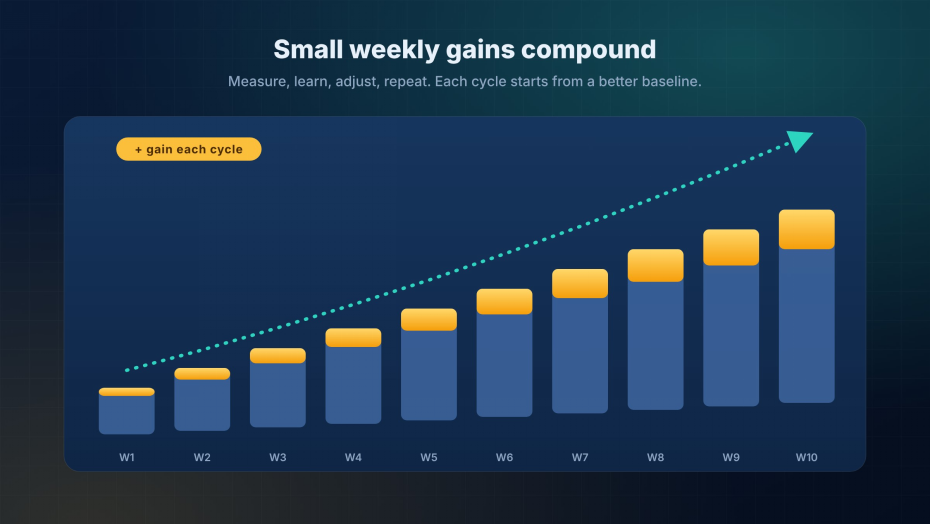
Small weekly gains, compounding.
Scaling lead generation in Malaysia does not require an endless budget. It requires a system that measures the right events, finds the biggest leak, tests one change at a time and moves money to what works. Performance marketing optimization turns advertising from a monthly expense into a loop that gets smarter every week, and that compounding improvement is what lets disciplined B2B brands outgrow bigger spenders.
Start with a tracking audit, pick the biggest leak and run one clean performance marketing optimization test this week. If you would like a second pair of eyes on your accounts, funnel and spend, the TAKO team is happy to help. You can also learn more about TAKO, explore our free marketing tools or read more on our blog.
READY TO STOP WASTING AD BUDGET?
Disclaimer: This article is for general information only and is not professional or financial advice. Results depend on many factors and cannot be guaranteed. Figures in the worked example are invented to show the maths. Platform rules and learning thresholds change, so check current documentation.