

In today’s hyper-competitive digital landscape, businesses are constantly searching for ways to stand out, connect with their audience, and drive tangible results. While traditional marketing methods still hold some value, the most successful companies are embracing a more scientific, analytical approach: Data-Driven Marketing. This isn’t just a buzzword; it’s a fundamental shift in how businesses understand their customers, optimize their campaigns, and ultimately achieve sustainable growth.
At TAKO, Data-Driven Marketing involves collecting, analyzing, and acting upon data to inform every marketing decision. It moves beyond intuition and guesswork, replacing them with verifiable insights that lead to more effective strategies and a higher return on investment (ROI). If you’re looking to elevate your business and make every marketing dollar count, understanding and implementing data-driven strategies is no longer optional it’s essential.
Why Data-Driven Marketing Matters More Than Ever
The digital age has brought with it an unprecedented amount of data. From website analytics to social media engagement, email open rates, and customer purchase histories, information is readily available. The challenge, and the opportunity, lies in making sense of it all.
Imagine running a marketing campaign without knowing who your target audience truly is, which channels they frequent, or what messages resonate with them. It would be like throwing darts in the dark. Data-Driven Marketing illuminates the path, providing clear insights into:
- Customer Behavior: What do your customers search for? What content do they consume? What influences their purchasing decisions?
- Campaign Performance: Which ads are performing best? Which emails are getting opened? Which social media posts are driving engagement?
- Market Trends: What are the emerging patterns in your industry? How are competitors performing?
- Personalization Opportunities: How can you tailor messages and offers to individual customers for maximum impact?
By answering these questions with concrete data, businesses can move from reactive marketing to proactive, predictive strategies. This leads to better allocation of resources, improved customer experiences, and ultimately, a healthier bottom line.

The Pillars of Effective Data-Driven Marketing
To successfully implement Data-Driven Marketing in your business, it’s crucial to understand its core components. Think of these as the building blocks that support a robust and insightful marketing framework.
1. Data Collection: Gathering the Right Information
The first step in any data-driven approach is to gather relevant information. This isn’t about collecting all data, but rather the right data that will help you answer specific business questions. Sources of data can include:
- Website Analytics (e.g., Google Analytics): Provides insights into user behavior on your site page views, time on site, bounce rate, conversion paths.
- CRM Systems (Customer Relationship Management): Stores customer contact information, purchase history, interactions, and preferences.
- Social Media Analytics: Offers data on engagement, reach, demographics of followers, and content performance across platforms.
- Email Marketing Platforms: Tracks open rates, click-through rates, conversion rates, and subscriber behavior.
- Advertising Platforms (e.g., Google Ads, Facebook Ads): Delivers performance metrics for your paid campaigns, including impressions, clicks, cost-per-click, and conversions.
- Surveys and Feedback Forms: Direct input from your customers about their experiences, needs, and opinions.
- Transaction Data: Purchase history, average order value, frequency of purchases.
It’s important to ensure your data collection methods are compliant with privacy regulations like GDPR and CCPA, prioritizing transparency and user consent.
2. Data Analysis: Turning Raw Data into Insights
Once you’ve collected the data, the next critical step is to analyze it. This is where raw numbers transform into actionable insights. Data analysis involves:
- Cleaning and Structuring Data: Ensuring data accuracy and consistency.
- Identifying Trends and Patterns: Looking for recurring behaviors, correlations, and anomalies.
- Segmentation: Grouping your audience based on shared characteristics (demographics, behavior, interests) to tailor your messaging.
- Predictive Modeling: Using historical data to forecast future outcomes, such as customer churn or potential sales.
- Attribution Modeling: Understanding which touchpoints in the customer journey contribute most to conversions.
Tools for data analysis range from simple spreadsheets for smaller datasets to advanced business intelligence (BI) dashboards and machine learning algorithms for larger, more complex data sets.
3. Data Interpretation: Understanding What the Data Means
Analysis provides the “what,” but interpretation provides the “so what?” This step involves understanding the implications of your findings and translating them into meaningful business opportunities or challenges. For example, if your data shows a high bounce rate on a specific landing page, the interpretation might be that the content isn’t relevant, the page loads too slowly, or the call to action is unclear.
4. Data Activation: Putting Insights into Action
This is where the rubber meets the road. Data activation means using your insights to make informed decisions and implement changes in your marketing strategy. Examples include:
- Optimizing Ad Spend: Shifting budget to the highest-performing channels or campaigns.
- Personalizing Content: Delivering tailored email campaigns or website experiences based on user behavior.
- Refining Targeting: Adjusting audience parameters for social media ads based on demographic and interest data.
- Improving Website UX: Redesigning pages or streamlining navigation based on user flow data.
- Developing New Products/Services: Identifying unmet customer needs through feedback and purchase data.
Practical Steps to Implement Data-Driven Marketing for Your Business
Ready to harness the power of Data-Driven Marketing? Here’s a step-by-step guide to get you started, regardless of your business size.
Step 1: Define Your Goals and Key Performance Indicators (KPIs)
Before you collect a single piece of data, clarify what you want to achieve. Do you want to increase website traffic, boost conversion rates, reduce customer churn, or improve brand awareness? Once your goals are set, identify the specific KPIs that will measure your progress.
- Example Goal: Increase online sales.
- Example KPIs: Conversion rate, average order value, number of transactions.
Step 2: Set Up Your Data Collection Infrastructure
Ensure you have the necessary tools in place to collect the data relevant to your KPIs.
- Install Google Analytics (or an alternative) on your website.
- Integrate your CRM with your marketing automation platforms.
- Utilize the analytics dashboards provided by social media platforms and ad networks.
- Consider setting up surveys or feedback mechanisms.
Step 3: Centralize and Clean Your Data
Data often resides in silos. Work towards centralizing your data into a single source of truth, if possible, or at least establish clear processes for cross-referencing information. This might involve using a data warehouse or a robust BI tool. Crucially, clean your data regularly to remove duplicates, correct errors, and ensure consistency. Dirty data leads to flawed insights.
Step 4: Analyze and Visualize Your Data
Regularly analyze the data you’ve collected. Look for patterns, trends, and anomalies. Visualization tools (dashboards, charts, graphs) are invaluable here, as they make complex data easier to understand and communicate. Focus on the insights that directly relate to your defined goals and KPIs.
Tip: Start with basic analysis and gradually explore more complex techniques as you become comfortable.
Step 5: Test, Learn, and Iterate
Data-Driven Marketing is an iterative process. Based on your insights, formulate hypotheses and run A/B tests. For example, if your data suggests a certain headline performs better, test it against another version.
- Hypothesis: Changing the call-to-action button color to green will increase click-through rates.
- Test: Run an A/B test with two versions of a landing page (one with a blue button, one with a green button).
- Learn: Analyze the results to see which button color performed better.
- Iterate: Implement the winning version and continue testing other elements.
Step 6: Continuously Monitor and Adapt
The market, your customers, and your competitors are constantly evolving. What worked yesterday might not work tomorrow. Continuously monitor your KPIs, review your data, and be prepared to adapt your strategies. This ongoing cycle of collection, analysis, activation, and optimization is what truly defines successful Data-Driven Marketing.
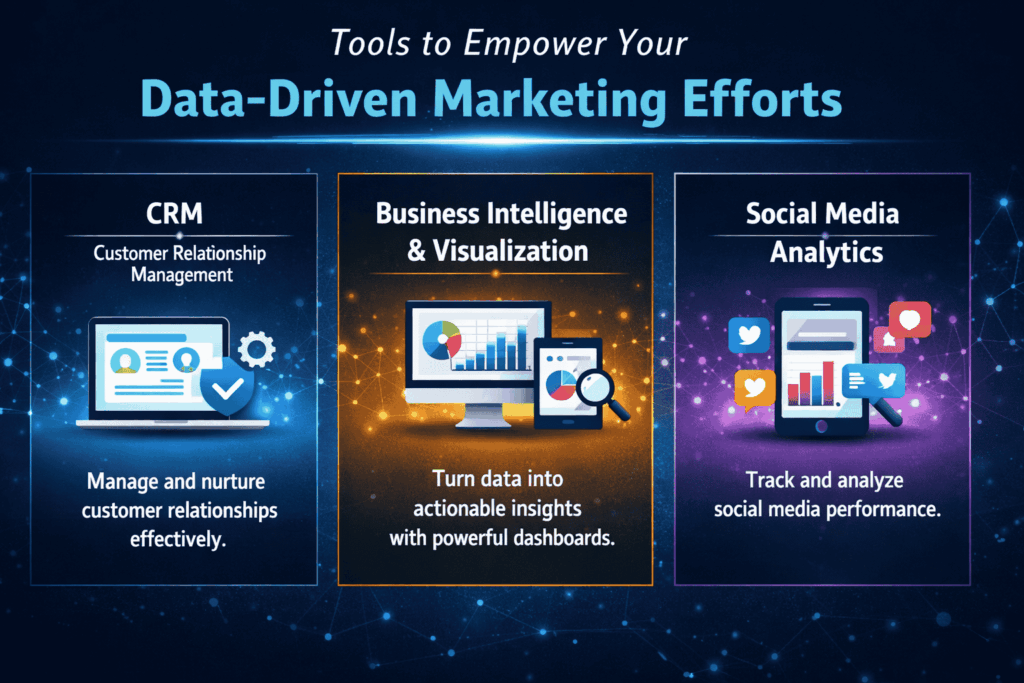
Tools to Empower Your Data-Driven Marketing Efforts
- Website Analytics: Google Analytics (free, robust), Adobe Analytics, Matomo.
- CRM (Customer Relationship Management): Salesforce, HubSpot CRM, Zoho CRM. These help manage customer interactions and sales data.
- Marketing Automation: HubSpot Marketing Hub, Marketo, Pardot. Automate email campaigns, lead nurturing, and personalize customer journeys.
- Business Intelligence (BI) & Visualization: Tableau, Microsoft Power BI, Looker Studio (formerly Google Data Studio – free). Transform complex data into understandable dashboards and reports.
- A/B Testing & Optimization: Google Optimize (being sunset, alternatives include Optimizely, VWO), Unbounce. Essential for testing different versions of your marketing assets.
- Social Media Analytics: Native analytics on Facebook, Instagram, LinkedIn, Twitter, plus third-party tools like Sprout Social, Hootsuite.
The Future of Data-Driven Marketing
As technology advances, so too does the sophistication of Data-Driven Marketing. Artificial intelligence (AI) and machine learning (ML) are increasingly playing a pivotal role, enabling:
- More Accurate Predictive Analytics: Forecasting customer behavior with greater precision.
- Hyper-Personalization at Scale: Delivering highly individualized experiences to millions of customers.
- Automated Optimization: AI-powered systems automatically adjusting ad bids, content recommendations, and email send times for optimal performance.
- Advanced Customer Journey Mapping: Understanding complex, multi-touchpoint customer paths in detail.
For businesses to remain competitive, staying abreast of these technological advancements and integrating them into their Data-Driven Marketing strategies will be paramount.
Conclusion
In an era where every click, view, and purchase leaves a digital footprint, ignoring data is akin to navigating blindfolded. Data-Driven Marketing provides the compass, the map, and the telescope needed to understand your audience, optimize your campaigns, and achieve your business objectives.
By systematically collecting, analyzing, and acting upon insights, you can move beyond assumptions and build marketing strategies that are precise, efficient, and highly effective. Embrace the power of data, and unlock a new era of growth and success for your business.
Remember, the journey to becoming truly data-driven is ongoing. It requires a commitment to continuous learning, adaptation, and a willingness to let the numbers guide your way. Start small, celebrate your wins, and consistently build upon your understanding. Your customers and your bottom line will thank you for it.
Is Data-Driven Marketing only for large corporations with big budgets?
Absolutely not. While enterprise-level companies use expensive AI suites, small businesses can practice highly effective Data-Driven Marketing using free or low-cost tools like Google Analytics, Mailchimp, or even simple spreadsheet tracking
How do I know if my data is “good” or “clean”?
Data integrity is the backbone of any Data-Driven Marketing effort. You can tell your data is “dirty” if you see: Duplicate customer entries in your CRM and Bot traffic skewing your website analytics.
How does privacy regulation affect my ability to use Data-Driven Marketing?
It depends on your goal, but for most businesses starting with Data-Driven Marketing, the Customer Acquisition Cost (CAC) and Customer Lifecycle Value (CLV) are the most vital.
Can I automate my entire Data-Driven Marketing strategy?
You can automate the actions (like sending an email when someone leaves a cart), but you should never fully automate the strategy.