
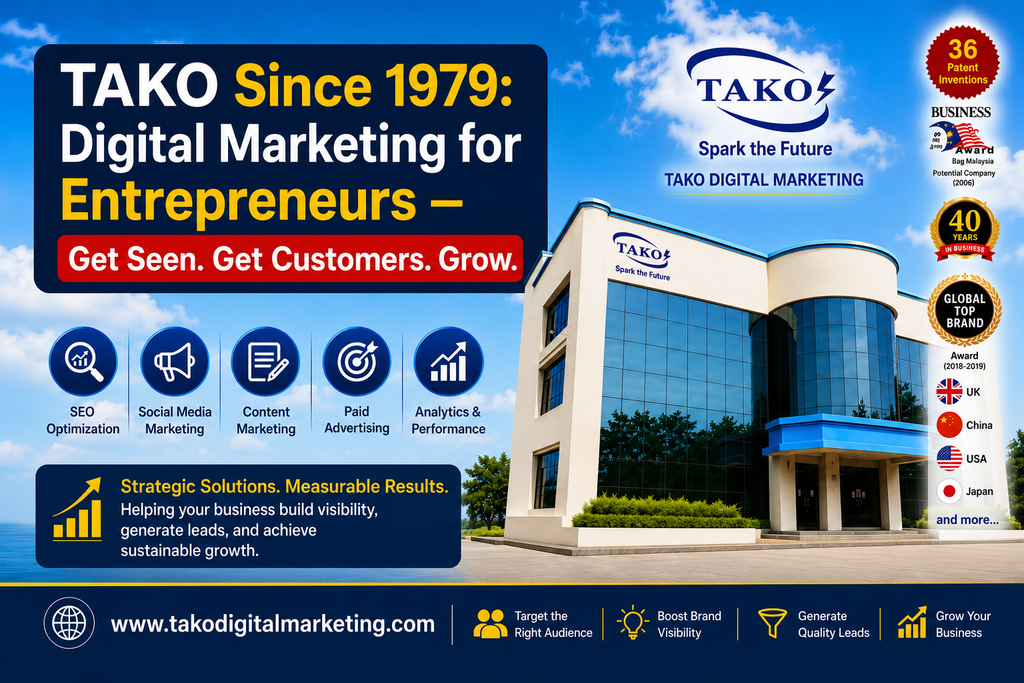
TAKO Since 1979: Empowering Entrepreneurs with Digital Marketing That Gets Results.
Introduction
Building a good business is only part of the challenge. The bigger question is whether the right customers can find, trust, and choose your business.
Today, potential customers may discover a business through Google, social media, online content, advertisements, or a company website before making a purchasing decision. This makes digital marketing more than simply posting on social media or running advertisements. It is about creating a connected digital presence that moves people from awareness to interest, trust, enquiry, and ultimately business growth.
For entrepreneurs, the goal is not to be everywhere online. The goal is to be visible in the right places, to the right people, with the right message.
What Is Digital Marketing for Entrepreneurs?
Digital marketing is the use of online channels and strategies to attract, engage, and convert potential customers.
For entrepreneurs, the most important areas typically include:
- Search Engine Optimisation (SEO) — helping potential customers find your business through search.
- Social Media Marketing — building visibility, engagement, and relationships with your target audience.
- Content Marketing — providing useful information that demonstrates knowledge and builds trust.
- Digital Advertising — reaching specific audiences through paid campaigns.
- Website Optimisation — turning online visitors into enquiries and customers.
- Lead Generation — creating a consistent path from digital visibility to business opportunities.
These activities work best as a system, rather than as separate marketing activities.
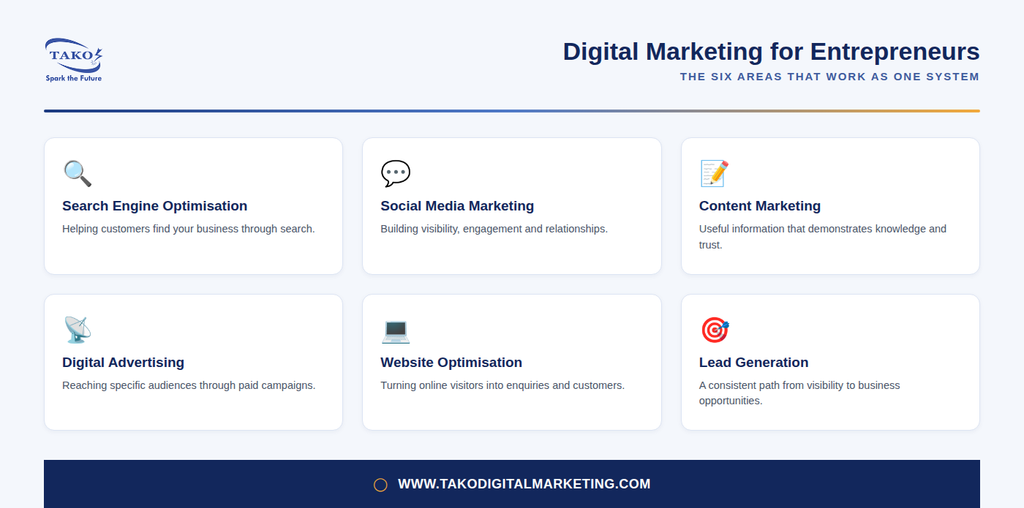
Six key areas of digital marketing
The Real Goal: From Visibility to Customers
Getting attention online is not the same as generating business.
A strong digital marketing strategy connects the customer journey:
Get Seen → Build Trust → Generate Interest → Create an Enquiry → Convert → Grow
For example, a potential customer may:
Search for a solution → Discover your website → Read useful content → Visit your social media → Contact your business → Become a customer.
If one part of this journey is weak, valuable opportunities can be lost.
A business may have website traffic but few enquiries. Another may have active social media accounts but little sales activity. Others may run advertisements without a clear landing page or follow-up process.
The objective is therefore not simply more traffic or more followers. It is creating a digital presence that supports measurable business outcomes.
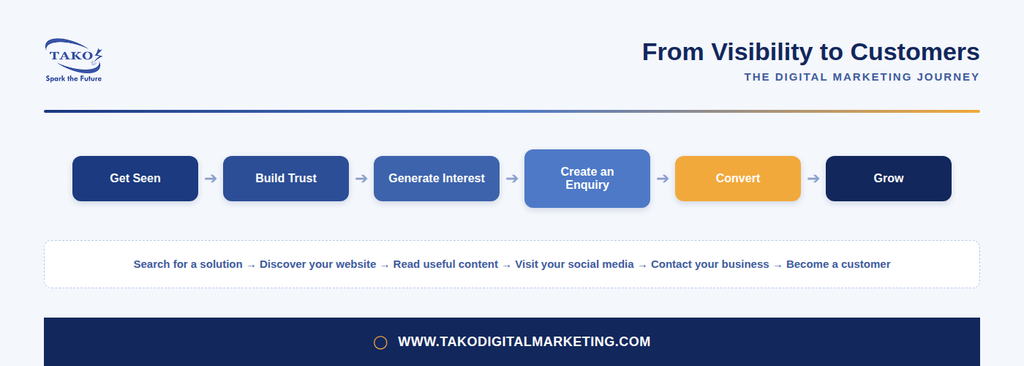
The digital marketing journey to business growth
5 Digital Marketing Priorities for Entrepreneurs
1. Build a Website That Works for Your Business
Your website is often one of the first places potential customers go after discovering your brand.
A professional website should clearly communicate:
- What your business offers
- Who you serve
- Why customers should trust you
- How your solution addresses their needs
- How they can contact or purchase from you
A website should not simply look professional. It should make it easy for visitors to take the next step.
2. Make Your Business Easier to Find
SEO helps your business appear when people are actively searching for products, services, or solutions related to what you offer.
Effective SEO begins with understanding what your customers search for and creating useful pages that answer those needs.
For entrepreneurs, this can create a valuable long-term digital asset because useful search visibility can continue bringing relevant visitors without paying for every individual click.
3. Use Social Media to Build Trust
Social media should be more than a place to announce products.
Entrepreneurs can use it to demonstrate:
- Expertise
- Customer success
- Products and services
- Behind-the-scenes activity
- Educational content
- Industry knowledge
- Customer experiences
The strongest social media content gives people a reason to trust the business, not simply a reason to notice it.
4. Use Advertising Strategically
Paid advertising can help businesses reach specific audiences more quickly.
However, advertising alone does not guarantee results. Before spending money, entrepreneurs should understand:
Who are we targeting? → What are we offering? → Why should they care? → Where will they go? → What action should they take?
A campaign should also be measured so that successful approaches can be improved and ineffective spending can be reduced.
5. Measure What Actually Matters
Digital marketing provides data that can help entrepreneurs make better decisions.
Useful metrics may include:
- Website traffic
- Search visibility
- Engagement
- Click-through rates
- Leads
- Enquiries
- Conversion rates
- Cost per lead
- Sales or other business outcomes
The important question is not “How many people saw my post?”
It is:
“Did our marketing help move the business closer to its goal?”
Key elements of an effective digital marketing strategy
A Simple Digital Marketing Strategy
Entrepreneurs do not need to start with a complicated marketing system.
Begin with five steps:
1. Define the Goal
Decide what you want digital marketing to achieve.
For example:
- More enquiries
- More qualified leads
- More online sales
- Greater brand awareness
- Entry into a new market
2. Understand Your Customer
Identify who your ideal customer is, what problem they have, what they search for, and what influences their purchasing decision.
3. Choose the Right Channels
You do not need to use every platform.
Choose the channels where your target customers are most likely to discover and engage with your business.
4. Create Useful Content
Answer customer questions, solve problems, demonstrate expertise, and provide evidence that your business can deliver value.
5. Measure and Improve
Plan → Implement → Measure → Improve → Repeat
Digital marketing should be treated as an ongoing process rather than a one-time campaign.
Common Digital Marketing Mistakes Entrepreneurs Should Avoid
Trying to Be Everywhere
Being active on every platform can spread limited resources too thin. Focus on the channels that support your business objectives.
Promoting Too Much
If every post is a sales message, audiences have little reason to engage. Balance promotion with useful, educational, and trust-building content.
Ignoring the Website
Social media can attract attention, but businesses still need a strong destination where customers can learn more and take action.
Measuring Vanity Metrics Only
Followers and likes can provide useful signals, but they do not necessarily represent business growth. Track enquiries, leads, conversions, and other meaningful outcomes.
Running Marketing Without a Clear Goal
Marketing becomes difficult to evaluate when there is no defined objective. Every campaign should have a purpose and measurable outcome.
What Makes Digital Marketing Effective?
Successful digital marketing is not necessarily about having the biggest budget.
It is about having a clear strategy.
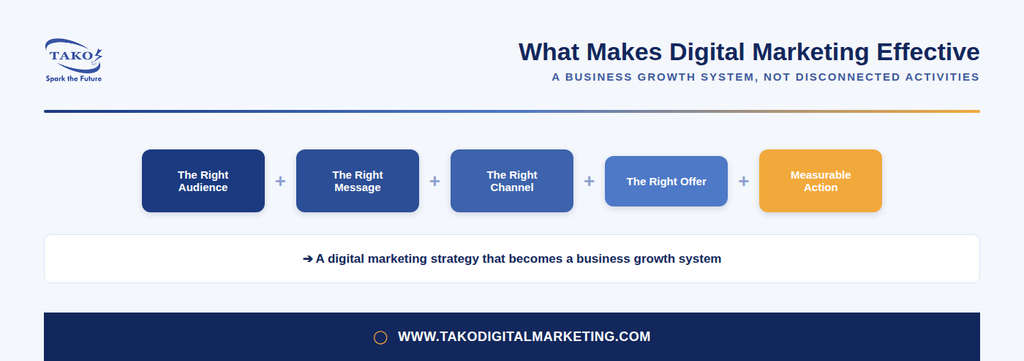
A strong approach connects:
The Right Audience + The Right Message + The Right Channel + The Right Offer + Measurable Action
When these elements work together, digital marketing can become a business growth system rather than a collection of disconnected online activities.
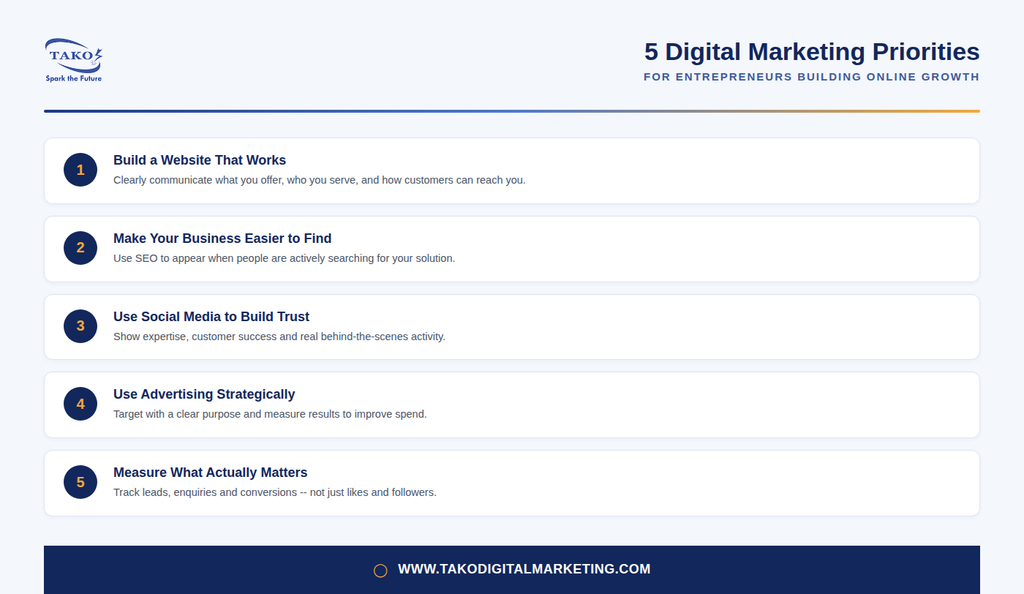
Five digital marketing priorities for entrepreneurs
TAKO Since 1979 Turning Digital Marketing into Business Growth
TAKO brings its long-standing business experience into a modern digital marketing environment, supporting businesses with strategies designed around visibility, engagement, lead generation, and growth.
TAKO’s digital marketing approach includes areas such as SEO, content marketing, social media marketing, digital advertising, website optimisation, and lead generation. Its digital marketing resources also emphasise structured SEO, content development, competitor research, performance measurement, and continuous optimisation.
The objective is simple:
Help businesses get discovered, build credibility, reach the right audience, and create more opportunities for growth.
The Entrepreneur’s Digital Marketing Checklist
Before investing further in digital marketing, ask:
- Can potential customers easily find my business online?
- Does my website clearly explain what I offer?
- Am I reaching the right audience?
- Does my content demonstrate expertise and build trust?
- Can visitors easily contact or buy from me?
- Am I measuring leads and business outcomes?
- Am I improving my strategy based on actual data?
If several answers are “no,” there may be significant opportunities to strengthen your digital presence.
Conclusion
Digital marketing is not simply about being active online.
For entrepreneurs, it is about being visible to the right people, earning their trust, and creating a clear path from discovery to action.
SEO can help customers find you. Content can demonstrate your expertise. Social media can build relationships. Advertising can expand your reach. A strong website can turn interest into enquiries.
When these elements work together, your digital presence can become more than a marketing channel — it can become a growth engine for your business.
Ready to Strengthen Your Digital Presence?
TAKO Since 1979 can help you develop a digital marketing strategy focused on visibility, customer engagement, lead generation, and sustainable business growth.
Get Seen. Get Customers. Grow.
Explore TAKO Digital Marketing
Frequently Asked Questions
What is digital marketing for entrepreneurs?
Digital marketing for entrepreneurs involves using online channels such as search engines, social media, websites, content, and digital advertising to reach potential customers and support business growth.
What is the most important digital marketing strategy for a small business?
There is no single strategy that works for every business. The right approach depends on the target audience, business goals, industry, and customer journey. SEO, useful content, social media, advertising, and website optimization can work together as part of an integrated strategy.
How can digital marketing help entrepreneurs get more customers?
Digital marketing can help businesses become more visible, reach relevant audiences, build trust, generate enquiries, and guide potential customers toward taking action.
Should entrepreneurs focus on SEO or social media?
They serve different purposes. SEO can help capture people actively searching for solutions, while social media can help businesses build awareness, engagement, and relationships. The strongest choice depends on where the target audience is and how they make purchasing decisions.
How do I know whether my digital marketing is working?
Measure outcomes that relate to your business goals. Depending on the objective, this may include qualified traffic, enquiries, leads, conversions, sales, or cost per lead rather than relying only on likes and followers.